
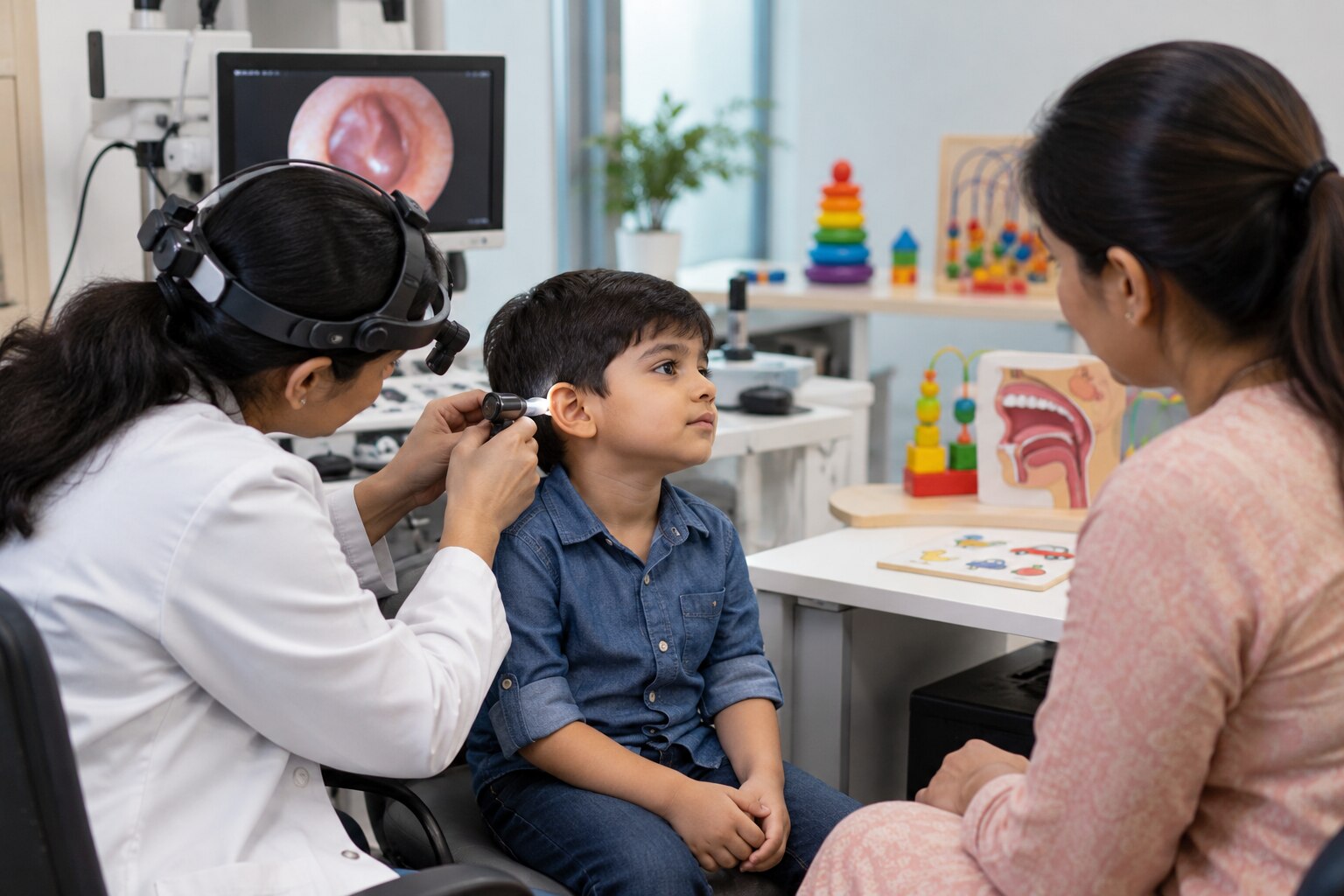
A child can hear a parent’s voice yet miss the quieter speech sounds that carry word endings, grammar, and pronunciation. By the end, you will know which signs deserve attention, how speech and hearing assessments differ, which test fits each age, and when a passed newborn screen is no longer reassuring.
Key takeaways
- Temporary hearing loss can hide quiet speech sounds, including /s/, /f/, and /th/.
- Track responses to voices, word clarity, vocabulary, and conversation by age.
- Hearing tests identify access to sound; speech and language tests assess communication skills.
- Seek reassessment when communication concerns continue after a passed newborn screen.
How temporary ear problems reduce access to speech sounds
Temporary conductive hearing loss does not make speech development irrelevant. It reduces the clarity and loudness of speech reaching the inner ear, so a child can respond to a voice yet miss quiet consonants such as /s/, /f/, or /th/.
Common causes include:
- Earwax blocking the ear canal and reducing sound transmission.
- Middle-ear fluid limiting eardrum movement after a cold or allergy.
- Otitis media causing pain, inflammation, and fluctuating hearing.
- An eardrum perforation or other eardrum problem changing how sound travels.
Speech can then sound muffled, especially in background noise. Inconsistent access makes it harder to distinguish speech sounds, learn new words, copy accurate pronunciation, and follow classroom talk. A child with normal hearing in one ear can still miss information when a speaker is distant, facing away, or surrounded by competing voices.
One uncomplicated ear infection does not automatically cause a speech or language delay. Risk rises with hearing loss that is persistent, recurrent, present in both ears, or occurs during an important period of learning.
Ask for a hearing assessment when middle-ear fluid lasts three months or longer, or sooner when communication, learning, or development already raises concern.
Tympanometry can show fluid or poor middle-ear function by measuring eardrum movement under changing air pressure. It cannot show how well the child understands speech, so behavioral or physiologic hearing testing is also needed.
What changes in listening and communication should you notice by age?
A pattern across ages matters more than one missed response. These hearing loss warning signs suggest that speech is not reaching a child consistently:
| Age | Expected listening and communication | Behaviour that needs attention |
|---|---|---|
| Birth to 3 months | Startles at loud sounds and quiets to a familiar voice | No startle, calming response, or reaction to sound |
| 4 to 6 months | Turns toward voices and begins vocal play | Not turning toward a speaker or showing little response to voice |
| 7 to 12 months | Responds to their name, babbles, and imitates sounds | Delayed babbling, inconsistent response to name, or reliance on watching faces |
| 12 to 24 months | Follows simple spoken directions and adds words | Does not follow familiar directions or gains words slowly |
| 2 to 3 years | Uses short phrases and is understood by familiar listeners | Unclear speech milestones, frequent “what?”, or watching lips to understand |
| 3 to 5 years | Answers questions, follows conversations, and speaks clearly enough for others | Misses group instructions, asks for repetition, or speaks much less clearly than peers |
A child with hearing in one ear can still miss speech in a noisy classroom, struggle to locate a talker, or appear inattentive. A passed newborn screen does not rule out later-onset, progressive, or fluctuating hearing loss.
Arrange hearing assessment when these behaviours persist, even if your child responds to loud sounds at home. An audiologist can measure hearing access; a speech-language pathologist can assess unclear speech separately, because normal hearing does not exclude an articulation or language disorder.
How hearing-related communication difficulty differs from a speech or language disorder
A child with hearing-access difficulty is inconsistent about what they hear, not simply slow to produce words. Watch for missed instructions, frequent “what?”, lip-reading, difficulty in noise, or better responses when the speaker is close.
Unilateral hearing loss can cause these problems even when the other ear hears normally; hearing in one ear is not the same as normal binaural hearing.
| Feature | What it suggests | What assessment clarifies it |
|---|---|---|
| Hearing-access problem | Misses speech, responds inconsistently, or struggles in noise; speech may improve with clearer access | Otoscopy, tympanometry, age-appropriate audiometry, and speech-language assessment |
| Speech delay versus language delay | Speech delay concerns late or limited spoken output; language delay concerns understanding, vocabulary, grammar, or social use | Receptive and expressive language testing |
| Articulation difficulty | Specific sounds remain inaccurate despite adequate hearing and otherwise appropriate language | Speech-sound, phonological, oral-motor, and structural assessment |
| Voice disorder | Abnormal loudness, pitch, quality, or endurance rather than trouble forming individual consonants | Voice and laryngeal evaluation |
| Resonance difficulty | Hyponasal speech from blockage or hypernasal speech from excessive nasal airflow | ENT and speech-language assessment |
Hearing loss can increase communication risk without causing a speech disorder. A child can have normal hearing and an articulation difficulty, motor-speech disorder, or language disorder, while another child has both hearing loss and a separate speech condition. A hearing test identifies access; it does not replace a speech-language evaluation.
Which hearing and speech tests fit an infant, child, or adult?
A reliable assessment moves from the ear to hearing access, then to speech processing and language. No single test answers all four questions, and a passed newborn screen does not rule out later-onset or fluctuating hearing loss.
- An audiologist takes a history and examines the ear canal and eardrum. Tympanometry measures eardrum and middle-ear movement as air pressure changes; an abnormal result can point to fluid, blockage, or eardrum dysfunction, but it does not show whether the child understands speech.
- For newborns and infants, otoacoustic emissions check inner-ear responses, while an auditory brainstem response estimates hearing thresholds through the auditory nerve and brainstem. Auditory brainstem response is useful when reliable behavioural responses are not yet possible.
- As the child matures, behavioural audiometry measures responses to tones through play, visual rewards, or raised hands. Test each ear separately; hearing in one ear is not the same as normal hearing in both ears.
- Add speech perception testing when development allows, especially for listening in noise, then request a speech-language evaluation for speech sounds, vocabulary, grammar, motor speech, voice, and social communication.
| Test | Main question answered | Best fit |
|---|---|---|
| Otoscopy and tympanometry | Is the canal, eardrum, or middle ear abnormal? | Any age |
| Otoacoustic emissions | Is the inner ear responding? | Newborns and young children |
| Auditory brainstem response | What hearing level is likely without a behavioural response? | Infants or unreliable responses |
| Behavioural audiometry | What sounds does each ear detect? | Developmentally ready children and adults |
| Speech and language assessment | Is communication affected beyond hearing access? | Children or adults with ongoing difficulty |
What to do after a passed newborn screen or continuing communication concerns
A passed newborn hearing screen does not rule out delayed-onset hearing loss. If your child stops responding consistently, says “what?” repeatedly, struggles in noise, or speech progress stalls, arrange a repeat audiologic assessment rather than waiting for the next routine visit.
Use this checklist:
- Ask for ear examination, tympanometry, and age-appropriate hearing tests. Persistent middle-ear fluid, one-sided difficulty, or changing results needs follow-up with an audiologist and ENT specialist.
- Use hearing aids or cochlear implants only after an individualized assessment. Fit, programming, daily wear, language exposure, and ongoing audiology and speech-language therapy all affect results; a device alone does not guarantee typical speech.
- Tell the school what access your child needs. Preferential seating, written instructions, captioned media, quiet testing, and remote microphone systems can reduce missed speech, especially in noise.
- Request a speech-language evaluation when pronunciation, vocabulary, grammar, fluency, or voice remains difficult despite adequate hearing access. A child can have a speech sound disorder with normal hearing.
- Seek urgent medical assessment for sudden hearing loss emergency symptoms, new one-sided hearing loss, facial weakness, severe vertigo, or rapidly worsening hearing. Do not treat these as ordinary speech concerns.
Dr.Phadke’s ENT & Rhinoplasty Clinic-08048038595 can help assess ear disease, persistent fluid, eardrum problems, or nasal and adenoid issues while audiology and speech-language professionals address communication access and development.
Related services
Best Microscopic Ear Surgery Specialist in Bavdhan , Kothrud,Pune and PCMC Best Microscopic Ear Surgery Specialist in Pune and PCMC Dr Aniruddha Phadke – Dr Phadke’s ENT & Rhinoplasty Clinic When it comes to advanced and... View service → |
Best Tonsil and Adenoid Surgeon in Bavdhan, Kothrud, Pune, PCMC If you or your child is suffering from recurrent tonsillitis, enlarged adenoids, breathing difficulties, snoring, or frequent throat infections,... View service → |
Frequently asked questions
How can temporary ear problems affect speech development?
Conductive hearing loss reduces the clarity and loudness of speech reaching the inner ear. A child may hear a voice but miss quiet consonants such as /s/, /f/, and /th/.
What communication changes should parents notice by age?
Watch whether your child responds to voices, understands speech, uses expected words, produces clear sounds, and takes part in conversation. Compare progress over time rather than relying on one behaviour.
How does hearing-related communication difficulty differ from a speech or language disorder?
Hearing-related difficulty results from limited access to spoken sounds. A speech or language disorder involves difficulty producing sounds, understanding language, using words, or communicating despite adequate hearing access.
Which hearing and speech tests fit an infant, child, or adult?
Infants may need diagnostic auditory brainstem response testing, otoacoustic emissions, and tympanometry. Older children may complete conditioned play or pure-tone audiometry, while speech-language assessment examines understanding, expression, speech sounds, and communication.
What should you do after a passed newborn hearing screen if concerns continue?
Arrange a repeat hearing evaluation and speech-language assessment when communication concerns persist. A passed newborn screen does not rule out hearing loss that develops later or fluctuates with ear problems.
Related service
Best Micro Laryngeal Surgery Specialist in Bavdhan,Pune & PCMC If you are searching for the best Micro Laryngeal Surgery specialist in Pune and PCMC, Dr Aniruddha Phadke at Dr Phadke’s ENT Clinic is a trusted... View service → |